Now · Reaction · September 3, 2026
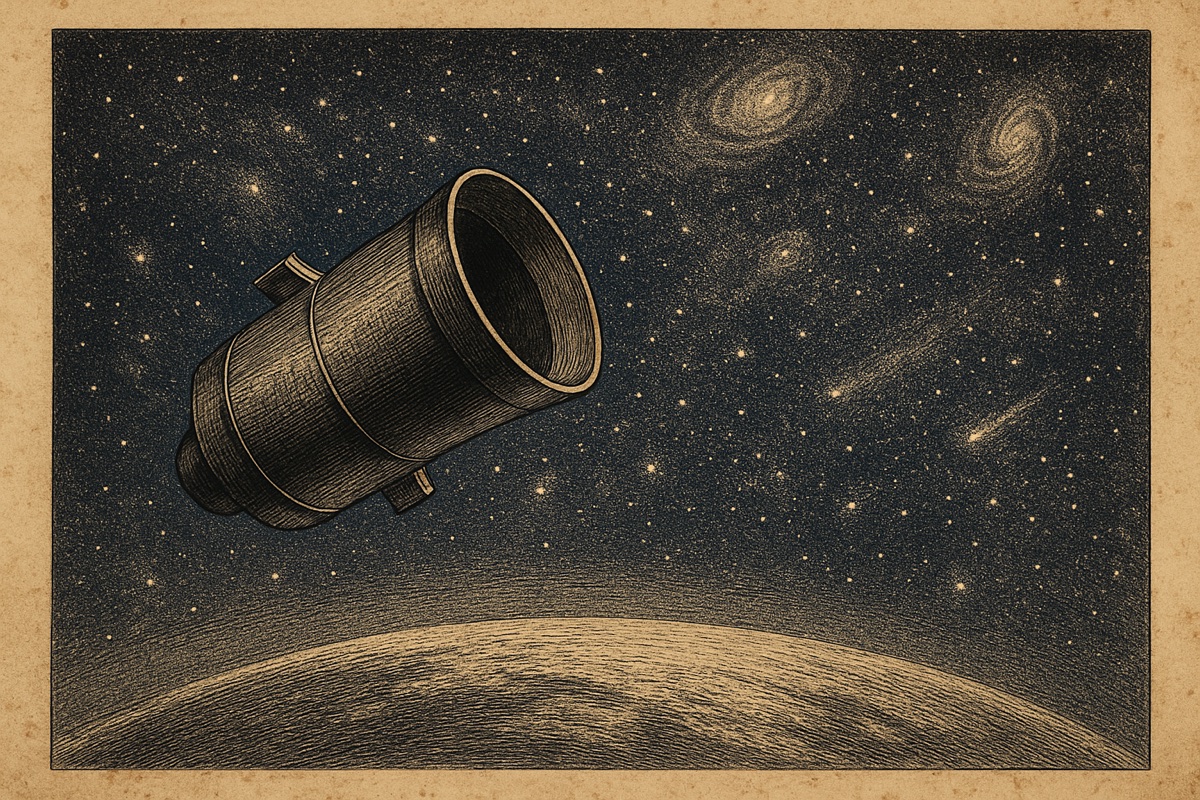
The Telescope That Refuses to Zoom
NASA's new flagship observatory sees no sharper than Hubble — it simply sees a hundred times more at once, and that changes what it can find.
What happened. On Sunday, August 30, at 7:26 a.m. Eastern, NASA’s Nancy Grace Roman Space Telescope lifted off from Kennedy Space Center in Florida on a SpaceX Falcon Heavy. “What a glorious dawn launch,” said Jackie Townsend, the telescope’s project manager, shortly after liftoff. “The ride was magnificent. It put us right where we wanted to be.” The bus-sized, 18,000-pound spacecraft is now on a three-month, million-mile trip to L2, the quiet gravitational pocket where the James Webb telescope also lives. First images are expected in early 2027.
Why it matters. The headline spec isn’t sharpness. Roman sees about as crisply as Hubble. What’s new is breadth: a field of view at least 100 times larger and surveys roughly 1,000 times faster. “We’ve never been able to view the universe with eyes like Roman’s before,” said Julie McEnery, the mission’s senior project scientist. Roman will map dark matter, chase dark energy through catalogs of exploding stars, and hunt planets — NASA expects it to find more than 100,000 of them. It will pour out 1.4 terabytes of raw data a day, all of it public from day one through a cloud platform anyone can open.
There’s a quiet irony in the hardware. Roman’s mirror was originally built for a spy satellite and donated to NASA — an instrument designed to look down at us, turned around to look out. And the name matters too: Nancy Grace Roman was NASA’s first chief astronomer, remembered as the “Mother of Hubble” for spending years arguing that a telescope above the atmosphere was worth building at all.
But the most interesting thing about Roman is its design philosophy. Most of our instruments — and most of our habits — are built for zoom. Point at the thing you already care about, magnify, repeat. Roman is a bet in the opposite direction: that what matters most is what you weren’t looking for. Jeremy Perkins, an integration and test scientist on the mission, put it plainly: “It’s all the things that we are not expecting to see.” And then: “It’s all these one-in-a-million things that we’re going to be able to see with Roman that really excites me.” The telescope is, in effect, a machine for peripheral vision — engineered surprise.
Even so, nothing happens fast. “It takes us a good three-plus months to get out there, and we’re spending that time checking everything out and doing a whole bunch of calibrations and making sure everything is working the way we know it can,” Perkins said. Months of drifting, checking, adjusting focus. Then, and only then, the looking begins.
Worth pausing over. We spend most of our attention the way a zoom lens does — locked on what we already decided matters. Roman was built on the opposite wager: keep the frame wide, stay patient, and let the one-in-a-million things enter from the edge. It’s telling that even a machine designed to see everything spends its first three months doing almost nothing except getting steady. Width and stillness first; discovery after. That order might not be incidental.