Life · Essay · October 14, 2026
What God Joined Can Come Apart
In November 2015 a Czech preacher said out loud a sentence that could not be said in Rome that autumn. Ten years on, in a country marrying less than at any time since the end of the First World War, that sentence applies, for the first time, to two free people equally.
A burnt dinner. According to the school of Rabbi Hillel, that was enough: a man whose wife had spoiled his food had “found some unseemly thing in her” in the sense of Deuteronomy, and could write her a bill of divorce. The school of Shammai insisted that unseemly meant unchaste and nothing less. Rabbi Akiva later added a third option: it is enough that you meet someone prettier. All of this is written in the Mishnah, tractate Gittin, and it is not a caricature. It is the record of a serious legal debate.
Into that debate the Pharisees walked up to Jesus with a question that sounds like a test because it was one: “Is it lawful for a man to divorce his wife for any reason?” Any reason. In other words: Hillel or Shammai? Which camp are you in?
A sermon from November 2015
In November 2015 a Protestant preacher, who writes on the blog Bible a Historie only as franciscus and, according to his profile, from Prague, preached on this text and posted the sermon there, where it can still be read today. Two weeks earlier, the Synod of Bishops on the family had ended in Rome, after three weeks of argument over, among other things, whether divorced and remarried Catholics may receive communion. In September Pope Francis had announced a simpler process for declaring a marriage null, that is, for finding that it never existed, due to take effect in December, and within half a year he would publish Amoris laetitia, an exhortation over one of whose footnotes the church then argued for years. That was the autumn: the loudest Christian quarrel over divorced people that I can remember.
Into all that, the preacher said something that was hard to hear in the noise. That the Pharisees were asking a false question. They had not come to ask what God wants; they had come to have confirmed what they already knew. And Jesus handed the question back: “What did Moses command you?” They: Moses allowed the bill to be written. He: for the hardness of your hearts. The bill of Moses was not a command; it was a concession. The preacher put it more sharply still: advice on how to pick, from nothing but bad solutions, the least bad one. How to limit damage that is coming either way, not because creation is faulty, but because we are.
And then the sentence I am writing this for. Jesus does not say that what God has joined, man cannot separate. He says: “What therefore God has joined together, let no man separate.” That is not a statement that it can’t be done. It is a command, and a command only makes sense where the thing can be done. “Don’t do it, man,” the preacher paraphrased. “Don’t do it for your own sake. Not for God’s law. Not for me. For your own sake, don’t.”
A marriage can be dissolved, the preacher said out loud in 2015. Nobody in Rome said so that autumn, not even in a whisper: the synod was arguing about what to do with people whose marriages had broken, not about whether the bond can break.
This is a Protestant sentence, and I leave it its edge. A Catholic reads it as a direct denial of what they confess: a valid, consummated marriage of the baptized cannot be dissolved by any human power. Orthodoxy has a third way: marriage is indissoluble, yet it can die; the church, out of mercy, recognizes this and allows a second marriage with penitential prayers in place of crowning. The preacher stands on the first side. I take from him only what holds on all three: a command, not a statement of fact.
God’s will is clear, he went on, and its name is faithfulness. Human failure can be forgiven. Divorce is the consequence of a sin that can be forgiven, “but it always remains a lesser evil, a failure, a warning and a burden whose consequences we carry, in some measure, all our lives.” And when we may divorce, nobody will tell us. It is a matter of conscience.
Ten years later
The year 2025, as the Czech Statistical Office added it up this spring: 42,500 weddings, the fewest since the end of the First World War. 21,200 divorces; 41 percent of marriages end in one. Nearly half of all children, 46.8 percent, were born outside marriage.
Nobody asks the Pharisees’ question anymore. Whether it is lawful to divorce a wife, or a husband, which Mark lists too, just to be safe, is not a question in 2026. It is a form. The court does not ask about the unseemly thing. Hillel won so completely that nobody needs to cite him; a burnt dinner would be a needlessly elaborate reason today.
The live question has moved four verses on, to a line hardly anyone remembers from the story. When Jesus finished, his disciples spoke up: “If this is the case of the man with his wife, it is not expedient to marry.” If that’s how it is, better not to marry at all. These are not Pharisees. These are his own people. And it is the oldest record I know of a position that, two thousand years later, most of the country I live in has adopted without needing Matthew for it: if it can’t be untied without consequences, better not to tie it at all. That 41 percent and that nearly half of the children are two sides of the same sentence.
Jesus did not contradict the disciples. He said: “Not all men can receive this saying, but those to whom it is given.” The preacher arrived at the same sentence in 2015 from the other side, from creation, and it sounds lax and isn’t: marriage is not a duty. It is a possibility. A gift, not an order. Nobody has to enter it. And precisely because nobody has to, the command applies only to those who walked in, and it applies to them for their own sake.
Who a command makes sense to
In 2015 the preacher was speaking to people with their share of failures behind them, perhaps in marriage too; they needed to hear that divorce is not the end of grace. In 2026 this text is more likely being read by someone who never married and doesn’t see why they should. Or by someone who is married and carries in their pocket an exit that costs nothing. The same holds for both of them as for the Pharisees: the question “is it allowed?” is false. It is, at least in the sense the Pharisees meant: nobody will stop you. Moses allowed it, the state allows it. The only thing left is Jesus’s sentence. And it is not addressed to them. It is addressed to man, which is to say, to me.
I will admit what bothers me about that sentence. It was spoken in a time when a wife, under the Law, could not write the bill at all, and a husband could write it over a burnt dinner; the command then protected the one who could not break it. Today both can leave, and so, for the first time in history, the command addresses two free people equally. That is not its end. That is the first age in which it can be obeyed at all. As long as you cannot leave, do not separate means nothing; only where leaving costs nothing does the sentence carry weight, and it is more than can be carried.
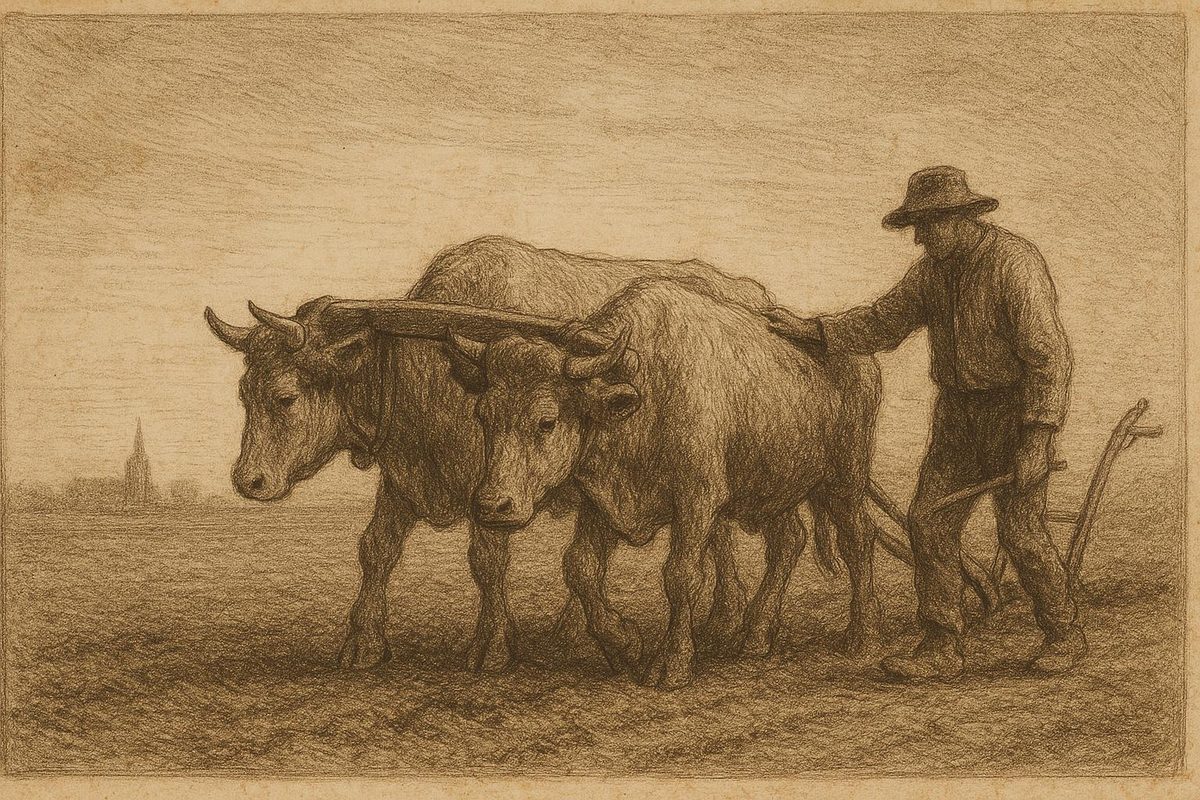
The hardness of heart Moses wrote the bill for, I know. Not from sermons. The preacher ended with an image he said someone had used before him: marriage is a yoke so heavy that sometimes it takes three to carry it. In 2015 that sounded like consolation. In 2026 I read it as a diagnosis. Two people who can leave at any time, and stay, do not need a law. They need a third. The preacher named him: God in Christ, the author of the sentence. I have not found another name for him.