Now · Reaction · September 3, 2026
Ahead of the Water
A glacier fell on the Bhote Koshi and killed the sensors meant to warn of it — what stayed ahead of the water was a telephone call, passed person to person.
On the morning of 26 August, a hanging section of glacier on Langtang Lirung, a Himalayan peak north of Kathmandu, sheared off and fell. An estimated one to two hundred million cubic meters of ice and rock dropped from around 5,200 meters, damming the Lhende Khola river near the Nepal–China border. When that debris dam burst, a wall of water, mud, and boulders tore down the Bhote Koshi gorge, taking the Rasuwagadhi border crossing, bridges, hydropower plants, and long stretches of the main road linking Kathmandu to Tibet.
By 31 August, Nepal’s disaster authority counted 903 dead and more than 4,300 missing, per state broadcaster Radio Nepal. By 3 September the confirmed dead in Nepal had passed 1,250, with thousands still unaccounted for on both sides of the border, among them pilgrims bound for Mount Kailash and hundreds of hydropower workers. Nearly 1.6 million people are affected. It is Nepal’s deadliest disaster since the 2015 earthquake.
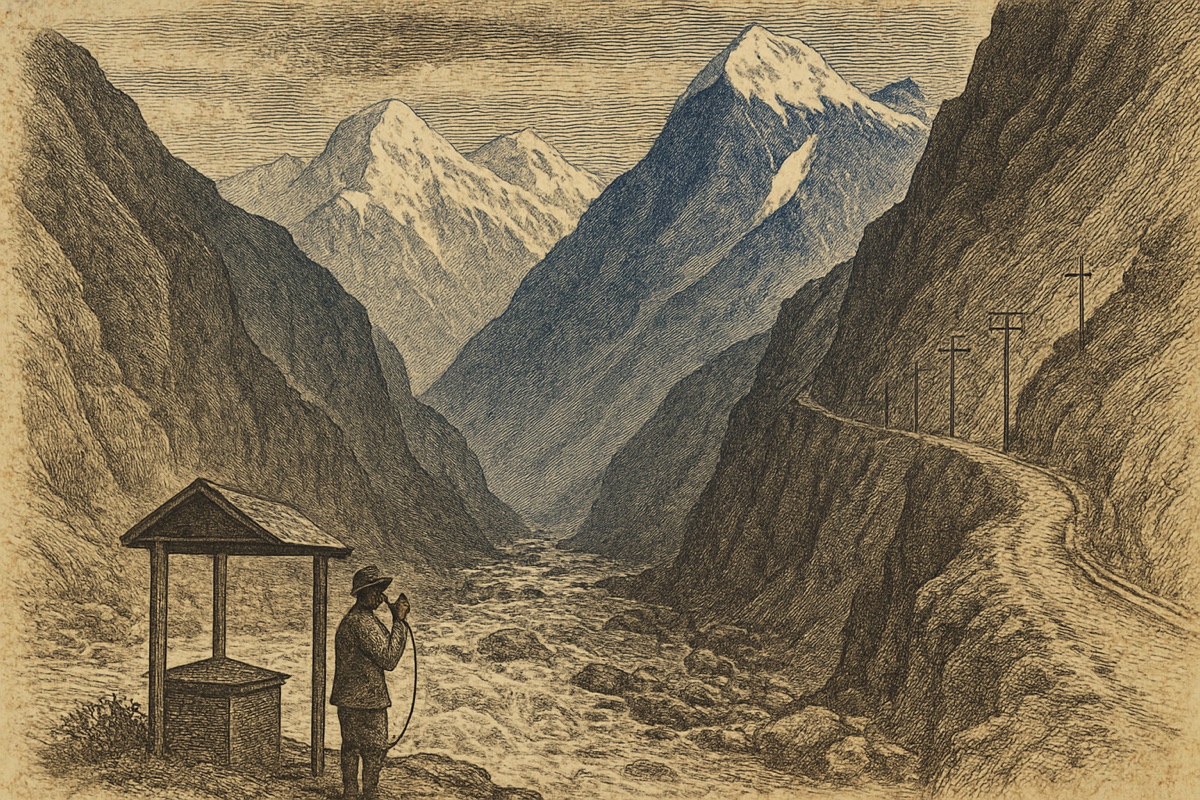
Here is the thread worth pulling. At 8:40 that morning, the automatic river gauge at Rasuwagadhi went silent; the flood destroyed the instrument built to announce it. For twenty minutes the country’s early-warning system was blind. Then, at 9:00, the Flood Forecasting Division in Kathmandu learned of the flood the oldest way there is: a telephone call from the district administration office in Dhunche, followed by word from an observer downstream at Betrawati. At 9:15 the first alerts went out. Within one minute, 679,295 text messages reached phones along the river, according to the Nepali Times. In Bidur, a school principal moved his 1,643 enrolled students to higher ground before the debris flow arrived. All the way down to Devghat, the warnings stayed ahead of the water.
Upstream, there were no minutes to give. The settlements nearest the border were struck before the first alert could be sent. That asymmetry, thousands of lives saved by a relayed phone call and thousands of names still on a missing list, is the shape of this disaster.
Glaciologists studying the collapse note that glaciers in Langtang retreated roughly 1.5 times faster between 2000 and 2023 than between 1964 and 2000, and that high-mountain zones above 4,000 meters have warmed by about 0.31°C per decade, leaving ice on slopes that can no longer hold it. Nepal is already arguing about sensors, thresholds, and budgets. Those arguments matter. They are not the whole story.
When the machines went dark, what stood between the water and the valley was attention: a civil servant who trusted what he heard, an observer who passed it on, a principal who did not wait to be certain. The oldest early-warning system is a person who notices and tells someone. You will probably never make a call like that. But you stand somewhere in someone’s chain. The question is simple: would you pick up?