Now · Reaction · September 3, 2026
Before the Feed, the Front Page
Danny Boyle opens Venice with the 1969 origin story of the attention economy — a front page we are all still scrolling.
What happened. On Wednesday, September 2, the 83rd Venice International Film Festival opened with the world premiere of Ink, Danny Boyle’s new film about the birth of the modern tabloid. Guy Pearce plays a young Rupert Murdoch; Jack O’Connell plays Larry Lamb, the editor Murdoch hired in 1969 to rebuild a dying broadsheet called The Sun into the paper nobody in Britain could put down. The screenplay is by James Graham, adapting his own 2017 stage play. The premiere drew a five-minute standing ovation, and the same evening George Clooney received the festival’s first Golden Lion for Lifetime Achievement. The festival runs through September 12.
The reviews landed fast and mostly warm. Time’s critic Stephanie Zacharek called it “a bold, entertaining piece of filmmaking” and described the film as “a fictionalized snapshot of a lost world and a forensic exploration of what happens when you give the people what they want, instead of what they don’t know they want.” Her closing verdict on the story it tells: “It’s a movie about the beginning of an end, brought about by enterprising men who just wanted to sell papers.”
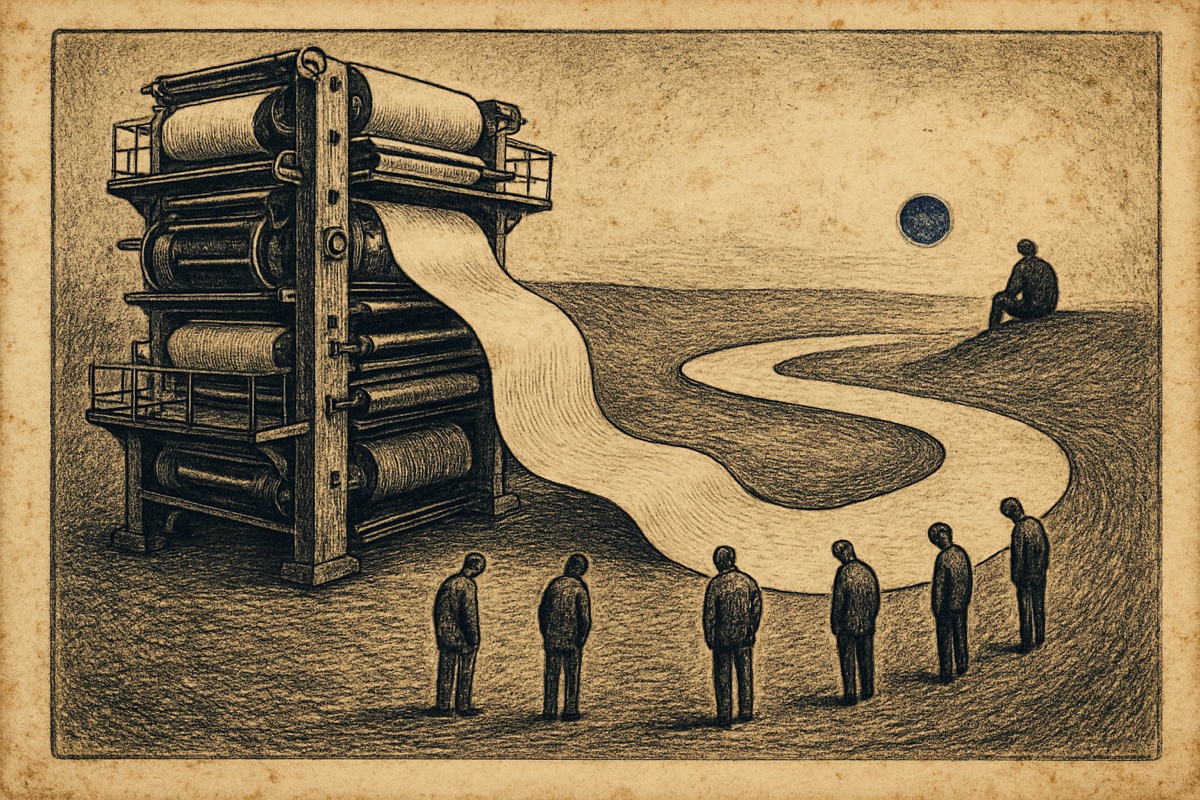
Why it matters. It is easy to watch Ink as a period piece, all hot metal and Fleet Street pubs. It is harder, and more honest, to watch it as an origin story we are still living inside. What Lamb and Murdoch worked out in 1969 — that the winning front page is the one engineered to be irresistible, refreshed daily, tuned to appetite rather than importance — is now the operating logic of every feed in your pocket. The tabloid was the prototype. The scroll is the product.
Boyle drew that line forward himself. Asked at the Venice press conference about artificial intelligence and the press, he said: “They’ll be able to replace journalists. Will that AI journalist speak truth to the power that’s created it?” A fair question from a director whose film is, at bottom, about what happens when the people who decide what we read decide it purely by what we will grab.
None of this requires a villain, and the film reportedly resists making one. Murdoch and Lamb did not force anyone to buy The Sun. They simply found the shortest path to what people already wanted and paved it. Fifty-seven years later, that path has been paved so smooth that most of us are on it before breakfast.
Worth pausing over. Zacharek’s phrase is the one to sit with: the difference between what we want and what we don’t know we want. Every algorithm on earth is now expert in the first category. It measures the tap, the lingering glance, the second helping. But the second category — the book you didn’t know you needed, the silence you didn’t know you missed, the question you’d never have typed into a search bar — cannot be measured, because it only surfaces when the grabbing stops. A front page, or a feed, can tell you what you reached for. Only a pause can tell you what you were actually hungry for. That may be the quietest argument Ink makes: the machine that gives us what we want was invented long before the smartphone, and the exit has been the same the whole time.