Now · Reaction · September 3, 2026
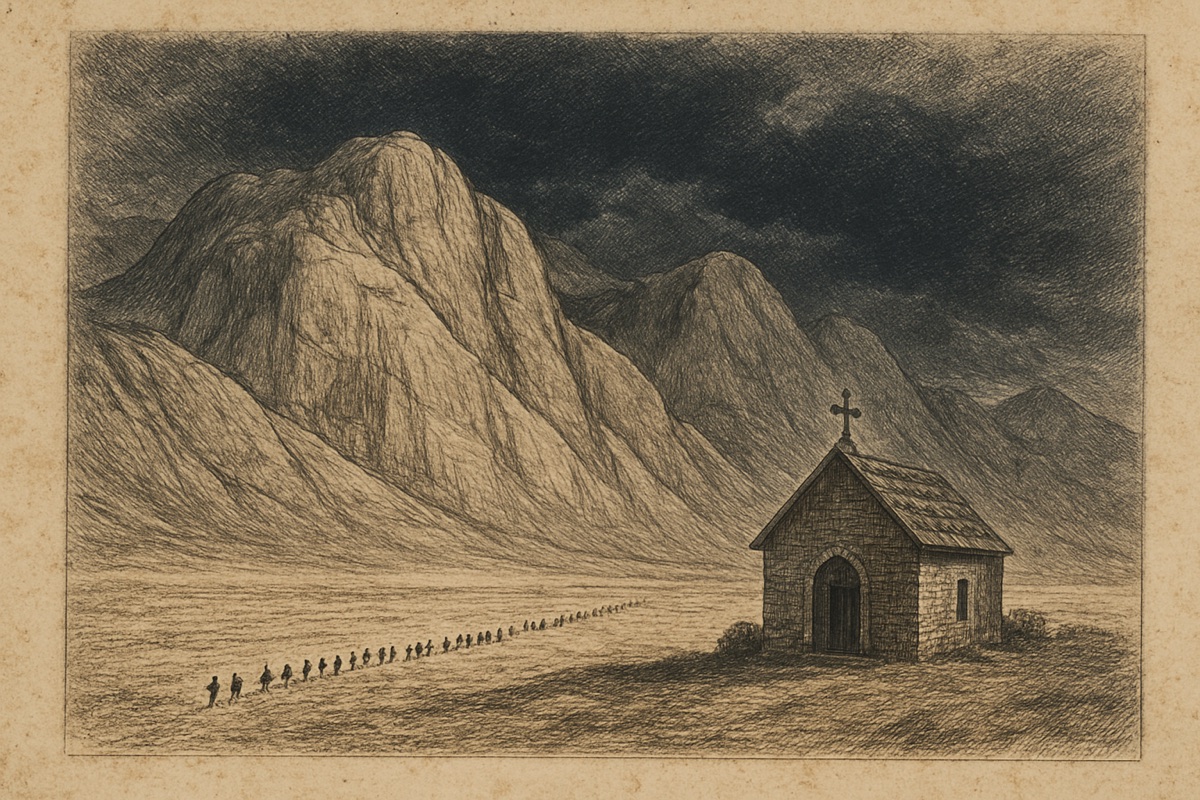
When the Refuge Needs Refuge
Sudan's Nuba Mountains absorbed close to a million people fleeing civil war; now the violence has climbed the mountain, and the local church is answering in an unlikely register.
For most of Sudan’s civil war, now in its fourth year, with tens of thousands killed and more than 12 million people displaced, the Nuba Mountains of South Kordofan were where people ran to, not from. The region has absorbed close to a million people fleeing the fighting; nearly half its population is Christian. That refuge is coming apart. On August 31, Religion News Service reported that violence has reached the mountains themselves, spreading around the key towns of Kauda and Heiban.
The chain of events is short and dated. June 19: a Catholic priest, Father Youhanna Al-Amin, and his church’s watchman, John Lemeya Adam, were shot dead at Holy Cross parish in Kauda. July 24: the Rev. Adel Idris Jongool, an Episcopal priest, was shot in an attack near the Anglican seminary in Debi and died of his wounds. In late July, two leaders of the Sudanese Church of Christ were abducted and freed after a few days. In August, four Samaritan’s Purse aid workers were detained and released two days later, while Najwa Musa Konda, a Christian relief worker held since April 1 and sentenced by a military court in July to a year in prison, remains cut off from her family. “We have not heard from her since her arrest because we are strictly banned from visiting,” a relative told Morning Star News in a report dated August 24.
The attackers are not a foreign army. The detentions were carried out by the SPLM-N itself, the rebel movement that governs the mountains. The killing of Jongool and the abductions are attributed, in reports shared with Anglican Ink, to a breakaway faction of roughly 1,500 mutinied fighters; sources disagree about who killed Father Al-Amin. The national war between Sudan’s army and the paramilitary RSF presses in from outside. Everyone involved claims to be defending somebody.
The Nuba church is one of the quiet growth stories of world Christianity. In 2002, the Anglican diocese of Kadugli counted about 5,000 members in ten congregations; today the two Nuba dioceses, Kadugli and, since 2024, Heiban, have more than 60,000 members in over 150 churches, built under a decade of aerial bombardment, according to Sudan Church Partners. And its instinct, now that the guns have turned inward, is worth noticing. Bishop Elsir Hassan Kuku of Heiban wrote to partner agencies that the church has “begun renewed efforts in our peace and reconciliation programme,” engaging all sides in the conflict and asking for prayer and practical support as it works for “peace, reconciliation, and restoration.” Almost none of this has reached the mainstream anglophone press.
Refuge was never really the geography. Mountains can be climbed; roadblocks go up on mountain roads too. What made Nuba a refuge was a community that kept receiving people, and when the terrain stopped being safe, its first move was not a wall but a reconciliation program. The difference between a hiding place and a shelter is that a shelter is someone’s daily practice. What in your own life do you take for terrain? It is probably someone’s work.